

What is the abrasion resistance of PTFE molded pall ring?
As a supplier of PTFE molded pall rings, I am often asked about the abrasion resistance of these remarkable products. PTFE, or polytetrafluoroethylene, is a well - known high - performance polymer, and understanding its abrasion - resistant properties in the context of molded pall rings is crucial for many industrial applications.
1. Introduction to PTFE Molded Pall Rings
PTFE molded pall rings are widely used in various industrial processes, such as distillation, absorption, and extraction. Their unique design, which features a cylindrical shape with internal ribs and external serrations, provides a large surface area for mass transfer operations. The PTFE material used in these pall rings offers several advantages, including excellent chemical resistance, high temperature resistance, and low friction coefficient.
PTFE is a synthetic fluoropolymer of tetrafluoroethylene. It has a very low surface energy, which makes it non - stick and highly resistant to a wide range of chemicals. This property is especially useful in applications where the pall rings come into contact with corrosive substances. For example, in the chemical industry, where aggressive acids or alkalis are commonly used, PTFE molded pall rings can maintain their structural integrity and performance over long periods.
The PTFE Molded Pall Ring is manufactured through a molding process. This process allows for precise control over the shape and dimensions of the pall ring, ensuring consistent quality and performance. The molded structure also enhances the mechanical strength of the pall ring, which is important for its long - term use in industrial columns.
2. Abrasion Resistance Mechanisms of PTFE
The abrasion resistance of PTFE is mainly attributed to its unique molecular structure. PTFE has a linear polymer chain with fluorine atoms surrounding the carbon backbone. These fluorine atoms form a protective sheath around the carbon chain, which reduces the intermolecular forces between the polymer chains and gives PTFE its low friction characteristics.
When the PTFE molded pall ring is subjected to abrasion, the low friction surface allows it to slide over abrasive particles rather than being cut or worn away. The fluorine - carbon bonds are very strong, which makes the polymer resistant to chemical and mechanical degradation. Additionally, PTFE has a high degree of crystallinity, which further enhances its mechanical properties and abrasion resistance.
However, it's important to note that the abrasion resistance of PTFE is also affected by factors such as the hardness and shape of the abrasive particles, the applied load, and the sliding speed. In general, PTFE performs well against fine - grained and relatively soft abrasive particles. For example, in applications where the pall rings are exposed to small dust particles or mild slurries, the PTFE molded pall rings can maintain their surface finish and functionality for an extended period.
3. Testing the Abrasion Resistance of PTFE Molded Pall Rings
To accurately assess the abrasion resistance of PTFE molded pall rings, various testing methods can be employed. One common method is the pin - on - disk test. In this test, a small pin made of the abrasive material is pressed against the surface of the PTFE pall ring, and the ring is rotated at a constant speed. The amount of material removed from the pall ring after a certain number of rotations is measured, and this provides an indication of the abrasion resistance.
Another testing method is the slurry abrasion test. In this test, the PTFE molded pall ring is immersed in a slurry containing abrasive particles, and the ring is agitated for a specific period. The weight loss of the pall ring after the test is measured, and this can be used to evaluate its abrasion resistance in real - world applications where the rings are exposed to slurries.
Through these testing methods, we have found that PTFE molded pall rings generally exhibit good abrasion resistance compared to other materials. For example, when compared to traditional plastic pall rings, PTFE molded pall rings can withstand more severe abrasion conditions without significant loss of material or performance.
4. Applications and the Importance of Abrasion Resistance
The abrasion resistance of PTFE molded pall rings is of great importance in many industrial applications. In the oil and gas industry, for instance, these pall rings are used in distillation columns where they are exposed to hydrocarbon vapors and small amounts of abrasive particles. The high abrasion resistance ensures that the pall rings can maintain their efficiency in mass transfer operations over long periods, reducing the need for frequent replacements.
In the pharmaceutical industry, PTFE molded pall rings are used in extraction processes. The abrasion resistance is crucial here because any wear of the pall rings could contaminate the pharmaceutical products. The non - stick and abrasion - resistant properties of PTFE ensure that the pall rings do not release any particles into the process, maintaining the purity of the final products.
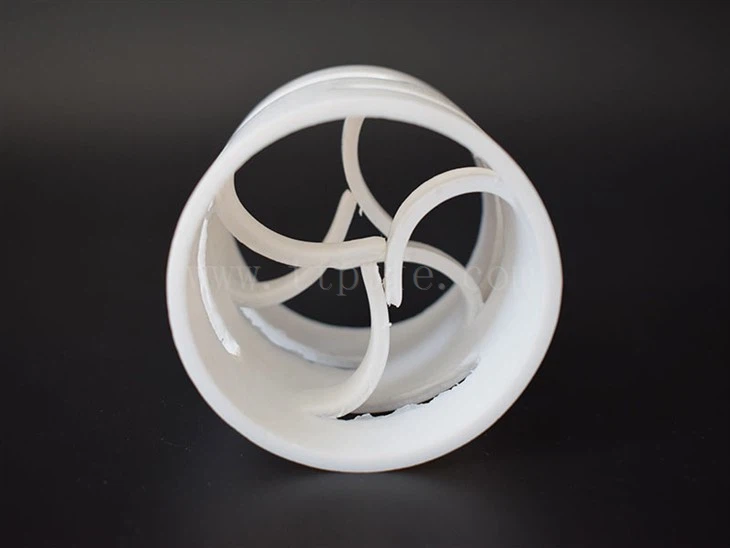

The PTFE Graphite Pall Ring and PTFE Plastic Pall Ring are also variants of PTFE - based pall rings. The addition of graphite in the PTFE graphite pall ring can further enhance its mechanical properties and abrasion resistance in certain applications. The PTFE plastic pall ring, on the other hand, offers a more cost - effective solution while still maintaining a relatively high level of abrasion resistance.
5. Improving the Abrasion Resistance of PTFE Molded Pall Rings
Although PTFE already has good abrasion resistance, there are ways to further improve it. One approach is to add fillers to the PTFE matrix. Fillers such as glass fibers, carbon fibers, or bronze powder can enhance the mechanical strength and abrasion resistance of the PTFE molded pall ring. These fillers act as reinforcement, increasing the hardness and wear resistance of the material.
Another method is to optimize the manufacturing process. By controlling the molding temperature, pressure, and cooling rate, we can improve the crystallinity and density of the PTFE, which in turn enhances its abrasion resistance. Surface treatments can also be applied to the PTFE molded pall rings to improve their abrasion resistance. For example, a thin coating of a hard - wearing material can be applied to the surface of the pall ring to provide an additional layer of protection.
6. Conclusion and Call to Action
In conclusion, the abrasion resistance of PTFE molded pall rings is a key property that makes them suitable for a wide range of industrial applications. Their unique molecular structure, combined with the precise molding process, gives them excellent resistance to abrasion under various conditions. Whether it's in the chemical, oil and gas, or pharmaceutical industries, PTFE molded pall rings can provide long - lasting performance and reliability.
If you are in need of high - quality PTFE molded pall rings or have any questions about their abrasion resistance and other properties, we are here to assist you. We have a team of experts who can provide you with detailed information and guidance on the best solutions for your specific applications. Contact us to start a discussion about your procurement needs and let us work together to find the most suitable PTFE molded pall rings for your operations.
References
- "Handbook of Fluoropolymer Science and Technology"
- "Industrial Applications of PTFE - Based Materials"
- Research papers on the abrasion resistance of polymers in industrial settings.
