

If you've ever worked with industrial materials, you've probably come across Teflon PTFE-polytetrafluoroethylene, the fluoropolymer famous for its non-stick properties, chemical resistance, and ability to withstand extreme temperatures. But for many engineers, manufacturers, and facility managers, one question looms large when specifying PTFE sheets for static-sensitive applications: What is the static dissipation property of teflon ptfe sheet? As a supplier of high-quality Teflon PTFE sheets, I get this question at least a dozen times a week, and for good reason. Static electricity might seem like a minor annoyance when you get a shock opening a door, but in industries like electronics manufacturing, pharmaceuticals, aerospace, or chemical processing, it can spark explosions, damage sensitive components, or ruin entire batches of product. Let's break down the science, the nuances, and how our PTFE sheets fit into this critical balance of material performance.
First, let's start with the basics: static electricity is the build-up of electric charge on the surface of an object, caused when two materials rub together (tribocharging) or separate quickly. The risk comes when that charge can't dissipate, leading to a sudden discharge-an electrostatic discharge (ESD). For a material to handle this, it needs to be either conductive (allowing charge to flow freely), static dissipative (allowing charge to bleed off slowly enough to prevent a spark but quickly enough to avoid build-up), or insulating (which traps charge, making it a high ESD risk).
Now, pure virgin PTFE is a standout in the world of insulators. Its electrical resistance is extremely high-we're talking 10^18 to 10^20 ohm-cm, which is way above the threshold for even high-resistance insulating materials. That means if you rub a pure PTFE sheet against another surface, the charge it picks up has nowhere to go. It stays trapped on the PTFE's surface for long periods, turning it into a static "battery" waiting to discharge. This is a key point: many people assume all PTFE is static-safe, but that's simply not true for virgin material. For example, if you use a standard virgin PTFE gasket in an electronics cleanroom, the static build-up could be high enough to fry a microchip the second it comes into contact.
But wait-PTFE is far more versatile than just pure virgin material. That's why manufacturers (including us, as a Teflon PTFE plate supplier) offer a range of modified PTFE sheets tailored for specific needs, including static dissipation. Filled PTFE sheet, for instance, blends virgin PTFE with additives like carbon fibers, graphite, bronze, or glass to adjust its electrical properties. The addition of conductive or semi-conductive fillers drops the surface resistance significantly-often to between 10^6 and 10^12 ohm-cm, which falls squarely in the static dissipative range. This is a game-changer for industries that need PTFE's core benefits (chemical resistance, temperature stability) without the static risk.
Let's get specific about how fillers work. Carbon fiber-filled PTFE, for example, creates a network of conductive pathways through the material. When static charge builds up on the sheet, these pathways let the charge flow across the surface and dissipate into the surrounding environment, preventing dangerous build-up. Bronze-filled PTFE is another option, with even higher conductivity for applications that might involve more frequent tribocharging, like moving parts in conveyor systems or machinery.
Not all modified PTFE is for static dissipation, though. Some filled PTFE formulas are designed to boost wear resistance or compressive strength, and their filler content won't impact static properties. That's why it's critical to specify the right grade for your ESD needs-something our team helps customers with every day. If you check our Filled PTFE Sheet page, you'll see we categorize our grades by their electrical and mechanical properties, so you can easily pick the one that works for your application.
Another type of PTFE sheet to consider for static-sensitive use is expanded PTFE sheet. Expanded PTFE (ePTFE) is made by stretching virgin PTFE to create a porous, microstructured material. While standard expanded PTFE is still an insulator, it can be treated with special coatings or infused with conductive particles to turn it into a static dissipative material. The porous structure of ePTFE also has extra benefits, like breathability and flexibility, which makes it ideal for gaskets, seals, or liners that need to conform to irregular surfaces and still handle static risk.
Of course, if you're working in an application where static build-up isn't a concern-like a high-temperature industrial seal for a chemical processing line that doesn't involve electronics or flammable materials-virgin material PTFE plate is perfect. Its high electrical resistance actually makes it a great insulator in those cases, preventing electrical current from passing through when it's not desired. We have a full line of virgin material PTFE plate, along with thickness options ranging from thin gasketing sheets to thick structural plates. If you need to check thickness specifics, our Thickness PTFE Plate Teflon Plate page has detailed specs for every grade we offer, so you can choose the right size for your project.

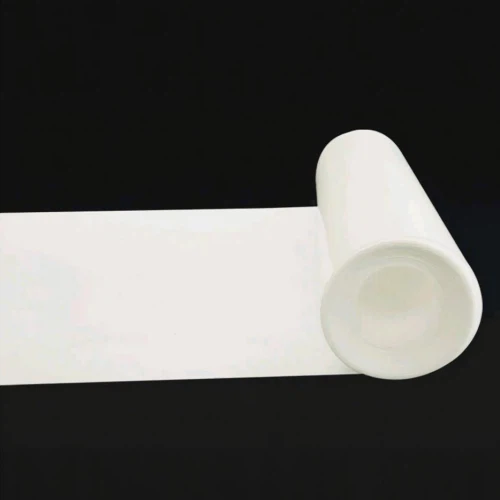
Now, let's clear up a common misconception: static dissipative PTFE isn't the same as fully conductive PTFE. Conductive materials have resistance below 10^6 ohm-cm, and while they can dissipate charge very quickly, they might not be suitable for applications where controlled charge build-up is needed, or where contact with electrical components requires a balance of insulation and dissipation. Our static dissipative PTFE grades are tested to meet industry standards for ESD protection, so they bleed off charge at a rate that's safe without being overly conductive.
We also need to talk about how static testing works for PTFE sheets. The two main metrics are surface resistance and volume resistance, measured in ohms. For static dissipation, surface resistance is the key number to watch-values between 10^6 and 10^12 ohms are the sweet spot. Conductive grades are below 10^6, insulators are above 10^12. As a Teflon PTFE plate factory, we test every batch of our modified PTFE sheets to verify their resistance, so you can be confident in their performance when you receive them. No guessing, no variable quality-just consistent, tested static dissipation when you need it.
Let's look at real-world examples to put this in context. A few months ago, we worked with a client that manufactures printed circuit boards (PCBs). They were using standard virgin PTFE fixtures to hold PCBs during the soldering process, and they were seeing a 15% failure rate due to ESD damage. The soldering process involves high heat, and the PTFE fixtures were rubbing against the PCBs and building up static charge. We recommended our carbon-filled static dissipative PTFE sheets, and after switching, their failure rate dropped to less than 1%. The material maintained its non-stick and heat-resistant properties, exactly what they needed, while eliminating the static risk.
Another client was in the aerospace industry, working on fuel system components. They needed a seal that could handle jet fuel, extreme temperatures (-65°F to 500°F), and static build-up from fuel flowing through the lines. Virgin PTFE would have trapped static, which in a fuel system is a major explosion hazard. We supplied their expanded static dissipative PTFE sheet, which had the flexibility to fit their irregular seal design, chemical resistance to withstand fuel, and static properties that met FAA requirements. It's been in use for over a year, and they've reported zero static-related issues.
So, to circle back to the original question: The static dissipation property of Teflon PTFE sheet depends entirely on the grade you choose. Virgin PTFE is an excellent electrical insulator with almost no static dissipation, making it unsuitable for static-sensitive applications. Modified filled PTFE sheets, infused with conductive or semi-conductive additives, fall into the static dissipative range, safely bleeding off charge to prevent ESD damage. Expanded PTFE sheet can also be formulated to be static dissipative, adding flexibility and porosity for specialized uses.
As a supplier, our goal is to help you choose the right PTFE grade for your needs, whether that's virgin material for insulation in a high-voltage component, filled static dissipative sheet for ESD protection in electronics, or expanded PTFE for flexible, breathable seals. We have all our grades documented online, from standard virgin material to specialized static dissipative formulas. If you're not sure which one you need, our team is here to walk you through the specs, test data, and application recommendations.
If you're ready to order a custom size or ask more questions about the static properties of our Teflon PTFE sheets, feel free to reach out to our team to discuss your requirements. We can provide samples, test reports, and pricing for any grade we offer, including thickness-specified plates, filled PTFE, expanded sheets, and virgin material.





