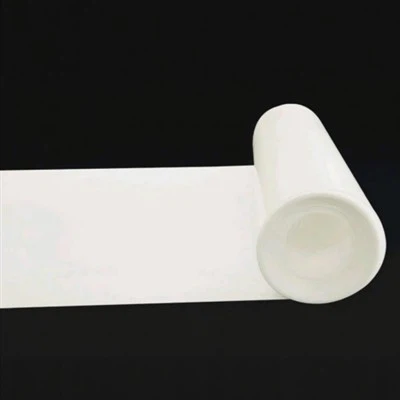
If you've ever worked with industrial plastics, you've probably encountered polytetrafluoroethylene (PTFE) – the non-stick, high-temperature resistant material commonly known as Teflon. As a long-time supplier of fluoroplastic products, one of the most frequent questions I get from engineers, machinists, and manufacturers is this: "Can PTFE plastic sheet be bent?" It's a simple question, but the answer isn't a straight yes or no – it depends on a few key factors, from the sheet's thickness and processing history to the temperature you're working at and how sharp you want the bend to be. Let's break this down, from the science behind PTFE's flexibility to real-world applications and what that means for your projects.
First, a quick refresher on what makes PTFE unique. Unlike most thermoplastics, PTFE has a crystalline structure that gives it its iconic properties: it can withstand temperatures from -200°C to 260°C, resists almost all chemicals, and has the lowest coefficient of friction of any solid material. But that same crystalline structure is also what makes it trickier to work with than, say, aluminum or even nylon. At room temperature, solid PTFE is relatively rigid – not brittle, exactly, but it doesn't bend like a flexible plastic grocery bag. That's why a lot of people are surprised when they first try to bend a standard 1/4-inch thick PTFE sheet and it cracks instead of forming a smooth curve.


So, to circle back: yes, PTFE plastic sheet can be bent, but only under the right conditions. The biggest variable here is thickness. Thin PTFE sheets – say, 0.05 inches or less – have enough flexibility at room temperature to form gentle bends, like a 90-degree bend with a radius of several inches, without any special processing. You don't need heat or tools for these thinner sheets; you can often bend them by hand if you take it slow. But if your sheet is thicker than 0.125 inches, room-temperature bending becomes far more difficult, and trying to bend it cold will almost always result in stress cracks or even complete breaks. That's where heating comes in – the second key factor in bending PTFE sheets.
PTFE has a glass transition temperature (Tg) of around 19°C, which means below that temperature, it's rigid and glass-like, and above it, it becomes more flexible and rubbery. Wait, 19°C is just above room temperature (which is usually around 20-22°C) – so at standard workspace temperatures, it's right on the cusp. That explains why thin sheets bend easily at room temp, but thicker ones don't: the thicker the material, the more heat it needs to raise its internal temperature above the Tg to soften it enough to bend. When you heat PTFE, its molecular chains become more mobile, allowing it to deform without cracking. For most PTFE sheets, the ideal bending temperature is between 120°C and 180°C – you don't want to go higher than that, because PTFE starts to decompose at around 260°C, releasing toxic fumes, and at temperatures above 200°C, it becomes too soft to hold a shape.
Bending also depends on the bend radius. The tighter the bend, the more the PTFE's molecular chains have to stretch and rearrange, which increases the risk of cracking. For thick PTFE sheets (1/8 inch or more), the minimum recommended bend radius is about 10 times the thickness of the sheet. So a 1/4-inch thick sheet would need a minimum bend radius of 2.5 inches, while a 1/8-inch thick sheet could safely bend to a 1.25-inch radius. If you need a tighter bend, you'll need to heat the PTFE more gradually, and maybe use a jig or form to hold the shape as it cools – once it cools back below the Tg, it will hold the bend permanently.
This flexibility (or lack thereof) is one of the things that makes PTFE suitable for different applications, but it's also why choosing the right form of PTFE for your project matters. If you need something that's easy to bend into complex shapes, thin PTFE sheet or even other PTFE products like thin wall PTFE tubing work well for smaller, flexible components. Wait, that's a great point – I often work with clients who come to me after trying to bend a rigid PTFE pipe or a thick sheet when they really needed a more flexible alternative. For example, if you're routing fluid lines that need to move with equipment vibration, thin wall PTFE tubing is designed to bend easily without cracking, which is perfect for that use case. Similarly, PTFE pneumatic tubing is built for repeated bending and flexing in automation and fluid power systems, where flexibility is non-negotiable. On the other end, PTFE Teflon pipe and thick PTFE sheets are used for things like chemical processing liners or gaskets, where rigidity and strength are more important than flexibility.
Another factor that affects bendability is the PTFE's processing method. Most solid PTFE sheets are made by a process called paste extrusion or compression molding. Compression-molded PTFE sheets tend to be more crystalline and rigid than extrusion-laminated sheets, which have a more uniform molecular structure that makes them slightly more flexible and easier to bend. At our facility, we test every batch of PTFE plastic sheet for bendability by sample-testing different thicknesses and processing histories, because even small variations in manufacturing can change how a sheet performs when bent. For example, a sheet that's been annealed (heated slowly and cooled evenly) will have less internal stress than an unannealed sheet, which makes it less likely to crack when bent. Unannealed PTFE often has hidden internal stress from the manufacturing process, so when you bend it, that stress can cause it to crack unexpectedly – something we warn all our new clients about, especially those new to working with PTFE.
Let's talk about common mistakes people make when bending PTFE sheets, because that's where most of the frustration comes from. The first mistake is trying to bend thick PTFE at room temperature. I've seen clients try to bend a 1/2-inch thick sheet cold, using a vise or a pipe clamp, and end up with a sheet that's split down the middle. That's not because PTFE is brittle – it's because they didn't heat it enough. The second mistake is applying too much heat too fast. If you blast a PTFE sheet with a heat gun, the surface will get hot enough to bend, but the inside will still be cold and rigid, leading to uneven bending and cracking. The right way to heat PTFE is evenly, using a convection oven, a hot plate, or a flexible heat blanket that covers the entire bend area for several minutes, until the sheet is pliable enough to bend without force. You should never force a bend – if it's not giving, it needs more heat.
Another question I get is: can bent PTFE sheets be reused or reshaped? For small, gentle bends, yes, as long as you heat it back up to the pliable temperature and adjust the shape. But PTFE is a thermoplastic, so it will melt if you heat it too much, and repeated bending and heating can cause it to lose some of its chemical resistance and tensile strength. For most industrial applications, once you've bent a PTFE sheet to a desired shape and it's cooled down, that's its final form – it's not going to bend again easily without re-heating.
Now, how does this apply to your specific project? Let's say you're designing a custom chemical tank liner that needs to have a curved edge to fit around a flange. If you use a 1/16-inch thick PTFE sheet, you can bend that cold with a simple jig, no problem. But if you're making a support bracket for high-temperature industrial equipment, you'll need a 1/4-inch thick PTFE sheet, which will need to be heated to 150°C and bent to a 2.5-inch minimum radius. Choosing the right thickness is half the battle – that's why we have a range of PTFE products, including PTFE plastic sheet, designed for different flexibility and strength needs. For applications that require even more flexibility than thin sheet, our thin wall PTFE tubing or PTFE heat shrink tubing can be perfect alternatives, especially if you're working with small, complex shapes or tight spaces where a rigid sheet won't fit.
I always tell clients that PTFE's bendability is a feature, not a bug – it just requires working with its unique properties, not against them. A lot of newer fabricators expect plastics to bend like acrylic or aluminum, but PTFE is a different beast entirely. If you take the time to heat it properly, use the right bend radius, and choose the right thickness, you can get smooth, crack-free bends every time. Over the years, I've helped hundreds of clients avoid costly mistakes by guiding them on the right PTFE product for their project – whether that's a rigid PTFE Teflon pipe for a high-pressure line or a flexible thin sheet for a custom gasket that needs to fit an irregular shape.
If you're not sure which PTFE product is right for your bending project, or you're looking for custom-cut sheets or tubes tailored to your specific bend requirements, don't hesitate to reach out. We've been supplying PTFE products to industrial manufacturers, engineers, and fabricators for years, and we can help you choose the right thickness, processing, and heating method to get exactly the bend you need, without cracking or compromising on PTFE's signature chemical and temperature resistance. Whether you need standard PTFE plastic sheet, custom-shaped components, or flexible tubing for any application, we have the expertise and products to meet your needs.