


Polytetrafluoroethylene (PTFE) Lining
What is PTFE Lined Tube
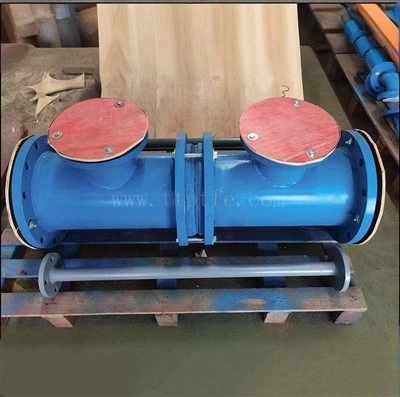
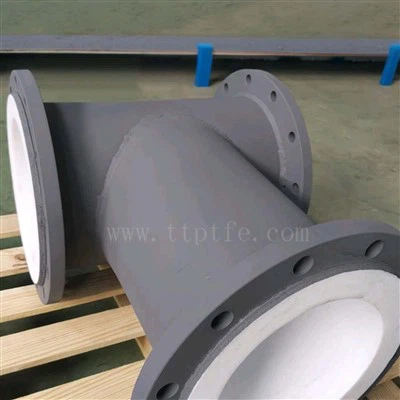
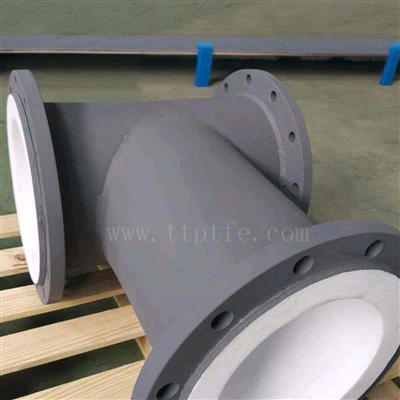
PTFE lined tubes are crucial components in industries requiring the safe handling of corrosive, sensitive, and high-purity fluids. Their unique properties make them indispensable for applications where chemical resistance, purity, and reliability are paramount.lt shall adopt steel components according to different technical requirements,and the thickness of PTFE wall shall be over 2mm. lf the temperature is less than 100℃, the production length shall be less than 6m:and if the temperature of 100-150℃, the length shall be less than 3m.and if the temperature of 150-180℃, the length shall be less than 2m.
Advantages of PTFE Lined Tube
Chemical Resistance: PTFE is highly resistant to a wide range of chemicals, making it suitable for transporting corrosive or reactive fluids without causing damage to the pipe.
Temperature Resistance: PTFE can withstand a wide range of temperatures, from very low temperatures to high temperatures, without losing its properties. This makes PTFE lined pipes suitable for applications where temperature variations are common.
Non-stick Properties: PTFE has a very low coefficient of friction, which means that substances flowing through PTFE lined pipes experience minimal resistance, leading to smoother flow and less pressure drop.
Easy to Clean: The non-stick properties of PTFE make it easy to clean and maintain, as substances are less likely to adhere to the pipe walls.



Why Choose Us
Our factory
The factory is located in Yancheng, the beautiful coast of the Yellow Sea. Founded in 2007, it has 150 sets of special equipment and 100 special pipelines. The factory continues to operate in ISO9001:2000 quality system.
Advanced technology
With strong technical force, there are more than 20 middle and senior technicians in undergraduate and junior colleges. The design adopts the most advanced Japanese technology, and the research and development speed is fast, which can meet the various needs of customers.
Wide range of applications
The pipes produced by Tongtong are mainly used in the fields of machinery, chemical industry, aviation, electrical and electronics, national defense industry, cutting-edge technology, medical and electrical insulation and electrical insulation.
Our produce
The existing PTFE tubes, PTFE Plates , PTFE gaskets, PTFE Fittings and Equipments, and has the ability to develop and produce various PTFE products. Excellent products are praised by customers at home and abroad.
Determine the Type of Chemicals and Temperatures Involved
The first step in selecting the right type of PTFE lined tube is to determine the type of chemicals flowing through the piping system and the temperature range they will be exposed to. PTFE-lined tube come in different grades, each designed to handle specific chemicals and temperature ranges. Selecting the grade compatible with the chemicals and temperatures involved in your application is important.
Consider the Size and Pressure Requirements
Your application's size and pressure requirements will also dictate the type of PTFE-lined tube you need. PTFE-lined tube come in various sizes and pressure ratings. It is important to select a tube that can handle your application's pressure and flow requirements without compromising the piping system's quality.
Evaluate the Type of Flanges Required
PTFE-lined tube come with different types of flanges. The type of flange required for your application will depend on the type of piping system and the nature of the application. Selecting the right flange type is important to ensure a secure and leak-free connection.
Determine the Flow Rate and Temperature
One of the most critical factors to consider while selecting the right size of PTFE Lined Tube is the flow rate and temperature of the fluid that will be flowing through the pipe. The fluid's viscosity and the pipe's nominal diameter play a significant role in determining the flow rate. The temperature of the fluid, as well as the surrounding air temperature, also plays a critical role. These factors will help you select the right pipe size, which in turn will determine the pressure rating.
Select the Right Pressure Rating
The pressure rating of a pipe is the maximum pressure that it can safely bear in terms of stress. This rating helps to ensure that the pipe doesn't burst under high-pressure situations, which can be quite catastrophic. The pressure rating of PTFE Lined Tube varies according to their size and the temperature of the fluid. It's important to note that the pressure rating of a pipe decreases as the temperature increases. So, ensure that you select the right pressure rating that can withstand the maximum pressure that your system might encounter.
Review the Quality Standards and Certifications
The quality standards and certifications of PTFE-lined tube are important considerations. The piping system must meet international standards and certifications to ensure reliability, efficiency, and safety. Selecting a reliable supplier that adheres to strict quality standards and certifications is important.
Seek Expert Advice
Choosing the right PTFE-lined tube for your application can be challenging. It is always helpful to seek expert advice from a qualified piping consultant or supplier. They can guide you through the selection process, provide valuable insight, and offer customized solutions that meet your requirements.
PTFE Lined Tube Processing Technologies
Processing can have more impact upon the performance of materials made from Polytetrafluoroethylene than with other types of polymers. For PTFE there are four key technologies available for manufacturing products. These are paste extrusion, isostatic moulding, ram extrusion and tape winding. For melt processable materials products can be manufactured by thermoplastic extrusion and transfer moulding. Each of these technologies suits particular types of product and has advantages and disadvantages – which will be considered specifically in relation to the conveyance of corrosive substances.
Simple Geometries
Paste extrusion is used for the production of hoses, pipe liners and short curved or reducing pieces for pipe fittings. It involves taking a fine powder PTFE; called this because of the small grain size and the narrow standard distribution of this grain size. This is chilled and a processing aid lubricant is added. It is warmed to allow the lubricant to fully wet the material, pressed into a billet, and extruded through an orifice to provide a circular section. The piece is finally loaded into an oven and sintered. It is the most expensive PTFE production process, but provides the smoothest surface finish, best mechanical performance and highest rates of permeation resistance.
Isostatic moulding uses coarser granular PTFE powders to fill a rubber bag within a pressure pot. The bag is placed over a mandrel which forms the internal diameter of the tube and using water pressure a loose powder fill is compressed onto the mandrel. It is subsequently removed from the vessel and placed in an oven for sintering. Its advantage is that it is a less expensive process, but the PTFE has a coarse surface finish and the random molecular orientation of the PTFE molecules reduces its permeation performance compared to paste extruded PTFE pipe liners and PFA lined fittings. CRP do not recommend this processing method for permeant duties, or those requiring cleanliness or cleanability.
Ram extrusion is now little practised for pipe liners; it is only seen in emerging economies. This process uses a pre-sintered granular powder and pushes a small amount into a vertical die and thumps it down, out through the base of the die and into a continuous oven. This can produce layering or laminations depending on the fill per machine stroke. As a very slow process there is a temptation to put more material in and this gives differential compression and areas of poor compaction. The product can therefore be quite permeable and is not recommended. Similarly tape winding is no longer widely practised. Here a paste extruded “tape” is wound tightly over a mandrel and subsequently sintered. This method provides a low tooling cost and versatility, but is prone to delamination when poorly fabricated.
Complex Geometries
For creating more complex shapes there are two key choices using PTFE in the isostatic moulding process, or moulding in PFA using transfer moulding. The isostatic process is similar to that used in pipe liners, except that the steel outer shell may be used as part of the tooling and the powder pressed into the inside rather than onto separate tooling. The isostatic process has a cost advantage, but again the product has a lower permeation performance, a rough surface and is not a tight fit inside the steel part. This means that any vacuum performance can only be obtained through wall thickness, which on smaller parts is difficult to obtain as the gap into which the loose material can be filled is limited and requires a compression ratio of 3:1.
Transfer moulding is an isothermal process in which tooling and steel components (which effectively form the outside of the tooling) are heated in an oven to 370° C for several hours. Molten PFA is then pushed relatively gently into the component, filling the void. The materials fill and tooling need to be able to manage the 30% shrinkage involved in the cooling of PFA back to solid and not to stress the material in doing so. PFA is an expensive material, but has the highest performance of all fluoropolymers – being better on permeation than even paste extruded PTFE and having the smoothest surface of all. It also has the advantage of translucency, meaning that any processing problems are usually visible in the lining. There are many grades of PFA available and it is critical to specify those that have the lowest melt flow rates, essential for corrosion performance.

PTFE material (Polytetrafluoroethylene) which is also known as teflon is a syntetic polymer type and it is widely used for inside lining of piping products in various sectors.
PTFE lining of pipes, fittings and spools is long term and effective solution for highly corrosive fluid pipelines (for instance sulphuric acid) and provides cost reduction. Because of this advantage PTFE lining application is used in chemical, mining, acid, alcohol, fertilising, pharmaceutical and desalinisation facilities. PTFE lining can be applied to high temperature (-190 to 220°C) and high pressure pipelines which transport/storage highly corrosive fluids.
PTFE material has high corrosion resistance against acid, caustic soda, chlorids, sulphates and other corrosive chemicals.
Purpose of PTFE lining to inside of piping products is to prevent metal pipe from high corrosive environment. This application also prevents high maintenance costs.
Lining is done by extrusion coating of heated teflon cylinder material to inside of pipeline. PTFE thickness can be according to customer demand and teflon material is used as virgin material according to ASTM D4895/4894. Lining application and required tests are done according to ASTM F1545-15A.
PTFE Lined Tube Design
Configuration
The essential design aspect of PTFE lined tube is that the straight spools provide the variable element as it is relatively easy to manufacture these at different lengths, whilst the fittings are manufactured to standard dimensions, which all remain the same within a bore size. This allows interchangeability without complete system redesign and provides the easiest and cheapest way of applying a product that has a complex manufacturing cycle and is unsuited to site running. Changes of direction are most cost-effectively accommodated by having rotating flanges on the pipe spools and fixed flanges on fittings.
Piping Support
Piping support should essentially be as for a flanged steel piping system. It must not be over supported as it is possible to put unnecessary strain on the pipework and force flanges out of alignment. Support close to flanges, ensuring that venting systems and access for bolting are not interfered with. Special pipe supports such as trunnions, brackets, sliders and feet should be factory fitted before lining – it is not acceptable to weld onto lined equipment.
Venting
Venting is a primary element of PTFE lined tube systems, its absence can be dangerous, but it is little understood. All PTFE and PFA lined equipment should have a venting system, most usually 5mm holes in the steel pipe. This serves two purposes. Firstly, without venting, any gases trapped between the lining and the steelwork will expand with an increase of temperature. These gases can arise by permeation through the lining. If they have nowhere to go the pressure on the back of the lining can cause it to collapse. Secondly, if for any reason the lining is damaged and leaks, the presence of a vent hole will provide an early warning of leakage and avoid the catastrophic failure of the piping.
With insulated lines, it is necessary to extend vents through the insulation by the addition of vent bosses and extension pieces. For permeant chemistries vent bosses are used with PTFE plugs. These serve to allow corrosive permeants which will become liquid on contact with the atmosphere to avoid corroding the metal around the vent and instead pass harmlessly through the PTFE plug and evaporate to atmosphere.
Ways to Avoid Common Problems with PTFE Lined Tube
Thermal Shock
Thermal shock, also known as thermal cycling, is a common problem in PTFE-lined tube. It occurs due to the sudden temperature fluctuations in the process fluid, leading to the expansion and contraction of the PTFE lined tube. This can cause the PTFE lining to crack or delaminate from the PTFE lined tube, leading to leakages, and further damaging the industrial process. To prevent thermal shock, you need to ensure that the tube is designed with expansion loops or flexible joints to absorb the thermal stress.
Chemical Incompatibility
PTFE is resistant to most chemicals, but certain chemicals like molten alkalis, fluorine, and fluorine compounds may cause swelling or excessive softening of PTFE lining. Also, due to the porosity of PTFE lining, certain chemicals can penetrate through the lining and cause damage to the PTFE lined tube. It is essential to ensure that PTFE is compatible with the process fluid before installing the PTFE lined tube. A chemical compatibility chart should be consulted before choosing the material for the lining.
Mechanical Damage
Mechanical damage to the PTFE lining can lead to leakage and further damage to the industrial process. Damage can occur during installation, handling, or operation of equipment. It is essential to avoid dragging the tube on the ground or allowing sharp or pointed objects to come into contact with the lining. PTFE lined tube should always be transported and handled carefully.
Poor Quality Linings
Poor quality linings can lead to premature failure of the PTFE lined tube and significant disruptions in industrial processes. The quality of the lining depends upon the quality of the PTFE resin, pigments, fillers, and other additives used. Ensure that the lining is from a reputable manufacturer, and the manufacturing process is reliable. The PTFE lining must be controlled and monitored during the manufacturing process to ensure consistent quality and performance.
Improper Installation
Improper installation can result in the distortion of the lining and the PTFE lined tube, leading to leakage and other problems. The lining should be installed using specialized tools and equipment to ensure proper adhesion of the PTFE lined tube, avoiding air pockets, and achieving even thickness. Additionally, ensure that all gaskets, O-rings, and seals are installed correctly to prevent leaks.
FAQ